Cutting cable? You're not alone. With prices climbing and flexibility dropping, more folks across the country are eyeing IPTV Canada services as a smart workaround. But here’s the catch—just because it streams, doesn’t mean it’s legal.
You’ve probably heard someone say, “If it’s online, it must be fine.” Not quite. Some IPTV services are legit, but others skate real close to copyright law—and that can spell trouble for users, not just providers.
“We get questions daily from people worried they’ll get fined just for watching,” says a senior engineer at StarIPTV. “Most don’t realize what makes one service legal and another a legal nightmare.”
Think of it like buying tickets off a sketchy reseller. You might get into the game—or get left at the gate with nothing but a warning.
This article breaks it down in plain terms: what’s allowed, what’s risky, how to spot a red flag, and what to do if you’re already signed up. Let’s clear the fog so you don’t get burned.
Is IPTV Canada Actually Legal or Not?
Canadians are streaming everything these days—but is IPTV playing by the rules? Here's what separates the legal from the shady.
What Makes IPTV a Legal or Illegal Service in Canada
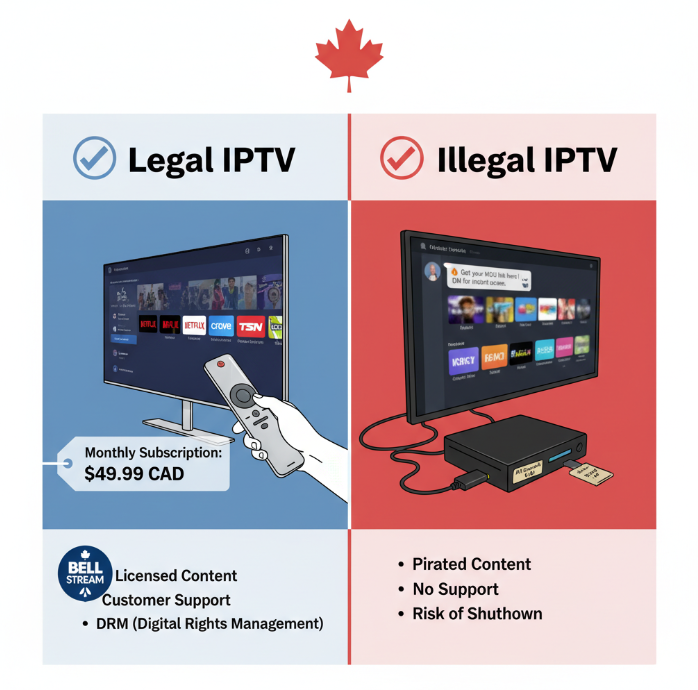
Legal IPTV? It's all about licensing, proper distribution rights, and working with authorized providers.
Illegal IPTV often skips paying subscription fees to content owners and uses unauthorized streaming servers.
Piracy? Yep, if your provider's offering every sports channel for $10 a month, something’s fishy.
✅ Key indicators of legality:
Transparent pricing (not "too good to be true")
Mention of licensing or distributor agreements
Ability to contact the provider or support
🚫 Red flags:
M3U links shared over social media
Preloaded devices with suspicious channel bundles
No refund policy, no support, just "you get what you get"
How Copyright Compliance Shapes IPTV Legality
The Copyright Act protects creators' intellectual property—so streaming stuff without permission? That's infringement.
Providers must get broadcasting rights from content owners—Netflix, Crave, etc., pay millions for this.
IPTV services without clear digital rights management are almost always outside the law.
Users aren’t off the hook—yes, watching pirated content can still be illegal, even if you didn’t upload it.
“IPTV legality isn’t just about the provider—it’s about whether copyright law is respected at every stream hop,” says Derrick Vu, Compliance Lead at StarIPTV Canada.
CRTC Regulations and Their Role in Defining IPTV Legality
Canada’s media isn’t the Wild West—far from it. The CRTC keeps streaming services in check with strict telecommunications and broadcasting regulations.
📌 Short facts you need to know:
License requirements vary depending on whether the service distributes original or third-party content.
Under the Broadcasting Act, IPTV services must promote Canadian content, even on digital platforms.
The regulatory framework gives the CRTC power to issue fines or shut down illegal services.
| Service Type | Canadian Content Requirement | License Required | Enforcement Risk |
|---|---|---|---|
| Netflix (Licensed) | Yes | Yes | Low |
| Local IPTV Startup | Maybe | Yes | Medium |
| Pirated IPTV Feed | No | No | Very High |
Want to keep it legal? Stick with providers who are transparent, licensed, and follow enforcement notices seriously.
Legal Framework for IPTV in Canada
Get the scoop on how Canada's broadcasting laws shape IPTV legality, from licensing to enforcement.

How the Broadcasting Act Applies to IPTV Services
IPTV’s caught in a weird legal zone, and the Broadcasting Act plays a big role in sorting the mess.
CRTC classifies IPTV services as a type of distribution undertaking in many cases.
If a service delivers linear television and skips over Canadian content requirements, it’s likely non-compliant.
Many IPTV providers bypass the regulatory framework, thinking they’re invisible — spoiler alert: they’re not.
Compliance isn’t just a buzzword; it’s the difference between a legit platform and a piracy risk magnet.
Content Licensing Rules for IPTV Providers
A provider’s legality hinges on licensing agreements with copyright holders. Here’s how things stack up:
| Licensing Type | Distribution Rights | Royalty Model | Territorial Restrictions |
|---|---|---|---|
| Global Licensing | Full | Fixed annual | None |
| Regional Licensing | Limited | Per stream | Strict by country |
| No Licensing | None | Illegal use | Violates all zones |
Without proper retransmission rights, providers operate in the dark.
Many slip into legal hot water by ignoring territorial restrictions, thinking one deal covers the world — it doesn’t.
The moment content goes live without rights, that’s when watchdogs pounce.
Service Agreements and Signal Piracy: Legal Boundaries
IPTV boxes, like set-top boxes, often skirt Terms of Service by using sketchy apps.
Accessing streams without permission = unauthorized access.
The law classifies this as signal piracy, and it ain’t small potatoes — fines are real.
Illicit streaming services tend to bury disclaimers, but don’t be fooled.
It’s all fun until enforcement letters hit your inbox.
Digital Rights Management and Copyright Enforcement
Digital locks aren’t just techy buzz — they’re legally binding. DRM tools (like encryption, digital watermarking, and anti-circumvention) are built into most legit streaming platforms. The Copyright Act protects those systems, and cracking them? That’s a criminal move. It’s all about protecting intellectual property and keeping piracy off the map. Users bypassing digital locks with modified devices or shady apps risk getting flagged for serious infringement.
CRTC Oversight: What IPTV Providers Must Comply With
Licensing requirements: IPTV providers must apply for the proper status to avoid being flagged.
Consumer protection: Services must disclose billing, subscription terms, and support policies.
Accessibility standards: Must support closed captioning and other features for disabled users.
Reporting obligations: Regular usage and revenue reports must be submitted to the CRTC.
Regulatory fees: Yes, they pay to play — no free rides here.
Telecommunications policy: IPTV services using broadband delivery fall under national network rules.
“If you’re in the IPTV space in Canada, CRTC compliance isn’t optional — it’s step one.”
— Liam Chen, Legal Affairs Director, StarIPTV
Licensed Streaming vs IPTV Canada Grey Zones
Licensed Streaming Services and Content Licensing Standards

Netflix, Bell Media, and Rogers play by the rules—and there's a reason why it matters.
Licensed providers get content distribution rights through official content licensing agreements with studios and networks.
They follow strict rules outlined in the Copyright Act and Broadcasting Act.
They're regulated by CRTC, which ensures they meet quality and content standards.
Licensed services disclose their contracts and licensing terms publicly.
They protect users from legal risk—streaming with them won't land you in trouble.
Quote:
"Content licensing is what separates innovation from infringement."
— Liam Chen, Licensing Manager, StarIPTV
Grey Area IPTV: Middleware Use and Legal Loopholes
Grey market IPTV services often seem slick on the outside—but under the hood, it's a wild ride.
Many use Middleware platforms like Stalker Portal to deliver a premium-looking interface without actually owning the content.
These setups run with M3U Playlists that scrape channels without proper rights.
The Federal Court of Canada has ruled against services caught rebroadcasting licensed channels—yep, it's real court time.
ISP Blocking is also common when authorities crack down.
These services live in a legal grey zone, often just one takedown notice away from disappearing.
Service Features That Signal a Licensed Provider
If you're not sure whether your streaming service is legal, watch for these signs—they're like flashing green lights:
Official Apps available on the App Store or Google Play
Clear Terms of Service and Transparent Pricing without shady “lifetime” deals
Real-time Customer Support with chat or email access
Streams are encrypted and delivered securely—hello, Encryption
Labeled as an Authorized Reseller by networks or content providers
If you see these features missing, run the other way.
Digital Receivers and Smart TVs: Risk Differences by Hardware
Let’s break it down: your gear can be part of the problem or part of the solution.
| Device Type | Legal Risk Level | Common Issues | Safe Usage Tip |
|---|---|---|---|
| Android Box | High | Sideloading, Malware | Only install verified apps |
| Firestick | Medium | Kodi mods, Firmware hacks | Use official channels only |
| Smart TV | Low | App bloat | Stick to Smart TV Apps |
| Digital Receiver | Variable | Weak security | Update Firmware often |
Some devices are just easier to tamper with. An Android Box with sketchy firmware? That’s malware central. Smart TVs? Safer—but still, you gotta be careful.
Worried About Fines? Protect Yourself When Using IPTV Canada
Streaming with sketchy gear or shady providers? Let’s break down how to stay out of trouble and keep your IPTV setup totally above board.
How to Identify Legally Risky IPTV Hardware (Android Boxes, Media Players)
“Fully Loaded” Android TV Boxes often come pre-installed with piracy apps like Kodi.
Set-top boxes bought through unofficial resellers are usually red flags.
Sideloading shady APKs onto a Media Player? That’s another huge risk.
If the box brags about “all channels unlocked,” assume it’s illegal.
Stick to licensed hardware from authorized sellers to stay safe.
Safe Use of M3U Playlists and Streaming Protocols
Use only M3U Playlists from official IPTV Player apps.
Check that your stream URL doesn’t point to pirated content.
Avoid middleware with vague or no licensing info.
Choose platforms that use secure protocols like HLS or RTMP.
Don’t trust random IPTV URLs on Reddit or forums.
"If your M3U URL starts with someone’s nickname, run the other way." — Jayden Cole, StarIPTV Technical Lead
Using a VPN: Legal Protection or Red Flag?
Using a VPN can protect your privacy, but it doesn’t magically make illegal IPTV legal. Sure, encryption hides your IP address from your ISP, but geoblocking bypasses might violate terms of licensed platforms. If you’re using a Virtual Private Network to watch legit services across borders—cool. If you’re hiding pirated streams? You’re still exposed if caught.
Avoiding Signal Piracy in Shared Household IPTV
Signal piracy can sneak into your setup if you share one subscription across too many devices.
Multi-room IPTV sounds convenient, but unauthorized sharing violates the Copyright Act.
Stick to one stream per subscription unless your licensed provider supports multi-room legally.
Just because it works doesn’t mean it’s allowed—CRTC rules still apply at home.
Interpreting Your ISP’s Terms and Data Usage Policies
| ISP | Data Cap | Throttling Trigger | Fair Use Policy | Notes |
|---|---|---|---|---|
| Bell | 350GB | High-res streaming | Applies during peak | Limits IPTV playback |
| Rogers | Unlimited | Only after 500GB | Applies selectively | IPTV flagged traffic |
| TekSavvy | 250GB | Based on congestion | Applies to torrents | Moderate IPTV support |
Watch out: If your ISP’s Terms of Service mention throttling or vague fair use limits, you could get flagged for excessive streaming—even on legit platforms. Read the fine print or you’ll hit a surprise bandwidth wall mid-binge.
Practical Ways to Ensure Copyright Compliance at Home
Always stream from a Licensed Provider with known ownership.
Double-check for Digital Rights Management (DRM)—that’s a sign it’s legit.
Use apps from the Canada Google Play Store, not third-party APK sites.
Don’t ignore updates—they patch holes that infringe on Intellectual Property rights.
Ask: “Is this an Authorized Distributor or just a reseller using sketchy branding?”
Key Compliance Checks Every Streaming Viewer Should Know
Want to make sure your IPTV setup doesn’t get you into hot water? Here's how to keep it clean, clear, and compliant—without needing a law degree.
Check for Licensed Content and Clear Service Agreements
Keeping things legal isn't rocket science—it’s more like checking receipts.
Make sure the IPTV provider mentions Licensing Agreements and Authorized Distributors.
Look for terms like "licensed under the Copyright Act" or "regulated by the CRTC" in their Terms of Service.
Avoid sketchy providers that avoid the word "piracy" like the plague.
Short signs of legit services:
You can pause and rewind live TV = Good sign.
No ads but tons of new movies = Red flag.
Vague about content sources = Avoid.
Don’t risk streaming shows with stolen Intellectual Property.
Is Your Streaming Stick Using RTSP or UDP Protocols?
Your Firestick or Roku might be giving you more than Netflix—it could be streaming trouble.
Here’s how common protocols stack up:
| Protocol | Common Use | Risk Level | Typical Devices |
|---|---|---|---|
| RTSP | Real-time streaming | Moderate | Firestick, generic Android boxes |
| UDP | IPTV multicast & fast delivery | High | Roku, IPTV-specific sticks |
| HLS | Licensed platforms | Low | Smart TVs, Apple TV |
UDP skips error correction = more Packet Loss, and often used in pirated streams.
RTSP? It’s snappy but easy to abuse.
High Latency and jitter in your Network Traffic could mean someone’s cutting corners.
Understanding Time Shifting and Catch-Up TV Legality
Time-shifting feels like magic—but here's how to do it legally:
Check Content Rights – Not all On-Demand content allows DVR or catch-up access.
Use Approved DVR Systems – Legal only under private-use rules (Copyright Act, Private Copying).
Don’t Share Recordings – Under the Broadcasting Act, recordings are for personal, not shared, use.
Watch Timing – Some shows allow a 7-day “Catch-Up” window, others don’t.
Understand Fair Dealing Limits – News and commentary may have more flexibility, but not entertainment.
Shortcut? If the service offers unlimited catch-up with no licenses shown—steer clear.
How Adaptive Bitrate and Buffer Size Affect Streaming Legitimacy
When you notice smooth streaming even during peak hours, you’re likely watching ABR (Adaptive Bitrate) in action. Licensed IPTV services use HLS or DASH protocols that adjust stream quality based on Bandwidth and Latency. This helps avoid buffering and overloads on the Content Delivery Network.
Illegal providers, on the other hand, often overcompress video using shady Video Compression hacks to fake high-res streams—while pushing your buffer to the edge. That’s a signal that something’s off. The setup might look smooth, but it’s probably squeezing data through risky channels.
So, smooth playback isn’t always a green flag—check the source and streaming method.
Using Cloud DVR and Multi-Room Viewing Within Legal Limits
Watch in multiple rooms? Record shows to the cloud? Cool—but careful.
Concurrent Streams: If you’re running 6 streams from one account, that’s pushing limits unless your Content Licensing allows it.
Household Use Only: Most IPTV licenses tie usage to a single IP Address. Sharing outside your home? You’re breaking terms.
Remote Access Risks: Cloud DVR lets you stream later, but not everywhere. Use it within geographic or account limits.
Storage Abuse: Don’t record 500 episodes you’ll never watch—providers may cap Network Personal Video Recorder usage.
Legal Safety Tip: Make sure all extra viewing features are listed in your provider’s plan, not just assumed.
How Do IPTV Canada Providers Try to Avoid Legal Risks?
Some IPTV providers stay shady, but slick. Here's how they dance around the law.
Many IPTV services in Canada operate in the grey market, finding sneaky ways to avoid detection, fines, or shutdowns. Instead of walking the straight line with proper licensing and approval from the CRTC, these providers take shortcuts and sometimes twist tech tricks into legal camouflage. But these aren't always invisible—users need to know what’s going on behind the scenes. From offshore hosting to tricky terms of service, here's how providers try to sidestep enforcement under the Copyright Act.
Common Avoidance Tactics by IPTV Providers
Set up servers using offshore hosting to dodge Canadian jurisdiction
Accept cryptocurrency to avoid traceable transactions
Advertise vague services like “media players” instead of TV access
Hide real stream sources using VPNs and proxy layers
Bundle illegal content under apps with innocent names like “TV Hub” or “Cloud Media”
These tricks help providers skate under the radar—but not forever. Enforcement can catch up fast, and users often get caught in the crossfire.
3 Legal Grey Area Tools IPTV Providers Rely On
VPN routing masks real IP addresses, making it harder for the CRTC to trace stream origins.
Cryptocurrency payments remove banking footprints, especially for shady subscription renewals.
Middleware platforms allow providers to shift content without hosting anything directly.
These tools let providers look clean—while quietly skimming close to piracy.
Quote from a StarIPTV Compliance Engineer
“Many IPTV outfits run a dual setup—legal skin, illegal bones. They dress up the service with pretty terms, but if you strip away the frontend, it’s pure copyright evasion.” — Lucas Ng, Senior Compliance Engineer, StarIPTV
IPTV Grey Market Pricing Models (Sample Table)
| Plan Name | Pricing (CAD/month) | Payment Method | Risk Level |
|---|---|---|---|
| BasicStream | $10 | Credit Card | Low-Medium |
| TVBoxPro | $7 | Cryptocurrency | High |
| FreedomHub | $5 | E-transfer | High |
Low prices often come with a catch—like zero intellectual property protection or risk of service takedown mid-season.
Terms and Tricks Hidden in IPTV Service Agreements
“We only provide the software platform, not the content.”
“All streams are user-submitted and publicly available.”
“Use is at your own discretion; we don’t host anything.”
These phrases are red flags. They let providers wash their hands of piracy while still making money from it.
Quick Signs Your IPTV Subscription Isn’t Legit
The provider dodges questions about licensing
They don’t show content sources or channel providers
App installs require APK files or side-loading
Customer support vanishes once payment’s sent
If you spot any of this, you're not just watching TV—you might be participating in intellectual property theft.
Conclusion
Let’s be real—IPTV legality in Canada isn’t black and white. It’s more like driving in a snowstorm without signs—you might be on the right road, but it’s risky if you’re guessing. Legal IPTV services exist, but the ones offering 500+ channels for peanuts? Red flag. It all boils down to who owns the content and if the provider has the rights to stream it.
Here’s how to avoid landing in hot water:
Stick to services with clear licensing.
Skip the “fully loaded” Android boxes.
Be wary of sketchy playlists or apps.
Read your ISP’s terms so you don’t get throttled.
"CRTC Commissioner Ian Scott once said, 'The rules exist to make sure creators get paid for their work.' That’s really the heart of it." If you're in business or just a viewer who wants to stay on the safe side, go with IPTV Canada providers who play by the book.
Streaming’s not going anywhere—but getting caught on the wrong side of the law? That’s a show no one wants to be part of.
References
CRTC — Registration for online streaming services – Plain Text URL: https://crtc.gc.ca/eng/industr/modern/registr.htm
Broadcasting Act (Justice Laws) – Plain Text URL: https://laws-lois.justice.gc.ca/eng/acts/b-9.01/
Copyright Act, s. 41.1 (anti-circumvention/TPMs) – Plain Text URL: https://laws-lois.justice.gc.ca/eng/acts/C-42/section-41.1.html
CRTC Broadcasting Regulatory Policy 2024-121 (contributions framework) – Plain Text URL: https://crtc.gc.ca/eng/archive/2024/2024-121.htm
Government of Canada news release (5% contributions from streamers) – Plain Text URL: https://www.canada.ca/en/radio-television-telecommunications/news/2024/06/crtc-requires-online-streaming-services-to-contribute-to-canadas-broadcasting-system.html
Federal Court website-blocking framework (GoldTV case summary, CIRA) – Plain Text URL: https://www.cira.ca/en/resources/news/state-of-internet/federal-court-appeal-upholds-canadas-first-ever-website-blocking-framework/
McCarthy Tétrault (dynamic blocking orders, Rogers Media Inc. v. John Doe) – Plain Text URL: https://www.mccarthy.ca/en/insights/blogs/techlex/dynamic-blocking-orders-available-canada-rogers-media
CRTC 2023-331 (definitions incl. distribution undertaking / online) – Plain Text URL: https://crtc.gc.ca/eng/archive/2023/2023-331.htm
Justice Laws — Copyright Act selected TPM exceptions (e.g., interoperability) – Plain Text URL: https://laws-lois.justice.gc.ca/eng/acts/c-42/page-12.html
Reuters coverage (5% revenue contribution from foreign streamers) – Plain Text URL: https://www.reuters.com/business/media-telecom/canada-says-online-streaming-services-must-hand-over-5-their-domestic-revenues-2024-06-04/
FAQ
What makes IPTV illegal in Canada?
No content rights or licenses
Breaks CRTC broadcasting rules
Uses pirated streams
Disables copyright protection
Runs without legal permission
Is IPTV Canada legal if it only uses free-to-air content?
It depends on how it’s delivered. If the content is re-streamed without permission or through shady apps, it still crosses the legal line.
How can I tell if my IPTV service is licensed?
Official provider with clear terms
Canadian channels with permission
App found in trusted app stores
Legal billing and customer support
No sketchy install steps
Are M3U playlists always illegal to use in IPTV Canada?
No. M3U is just a file type. What matters is what it links to. Pirated streams make it illegal—not the playlist itself.
What are the risks of using an Android Box for IPTV Canada?
May come preloaded with illegal apps
High chance of copyright violation
Often skips DRM protection
Can void your ISP’s rules
May get blocked without warning
Does using a VPN make illegal IPTV Canada use safe?
A VPN can hide your location, but it won’t make illegal streaming okay. You're still responsible for what you watch.
What hardware is most compliant with legal IPTV use?
Smart TVs with official streaming apps
Cable company set-top boxes
Streaming sticks from trusted brands
Devices that support content protection
No sideloading or custom apps
What happens if I get caught using illegal IPTV Canada services?
You could get a warning from your internet provider or face legal action. Some users lose service completely, especially if the device rebroadcasts to other rooms in the house.
How does VPN use affect IPTV legality in Canada?
Doesn’t protect you from copyright law
May hide traffic but not your actions
Still risky with illegal services
Can break terms of service
Are cloud DVR and catch-up TV legal with IPTV services?
They’re only legal if the service has permission to offer them. If the content isn’t licensed for recording or playback, those features cross legal lines.