Is IPTV illegal in Canada 2026? That’s the question buzzing around forums and Facebook groups these days. With cable prices climbing and streaming options exploding, many Canadians are turning to IPTV to save a few bucks and get more channels. But not every service plays by the rules—and that’s where things get murky fast.
Some IPTV providers are fully licensed and above board, while others sneak around copyright laws like a neighbor “borrowing” Wi-Fi that isn’t theirs. The CRTC has said in the past that accessing unlicensed content can breach copyright law, and that could land users in hot water—or at least with a nasty Notice and Notice warning from their internet provider (see the Government of Canada’s consumer guidance on “Notices to Canadian Internet subscribers”).
Before signing up for any IPTV deal that sounds too good to be true, it’s worth knowing what’s legal and what’s not. This guide breaks it all down in plain English—so you can stream smart, stay safe, and keep those Saturday night hockey games running smoothly.
Is IPTV legal or illegal in Canada?
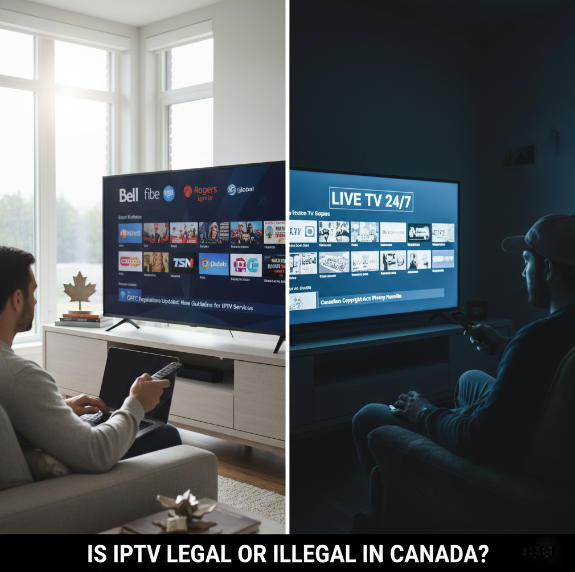
“It depends on the source.” Those were the words of Mark G., a Toronto-based telecom lawyer with over 15 years in digital broadcasting law, during a sit-down we had recently on the hot topic of IPTV legality in Canada. His view echoes what many experts and regulators across Canada continue to underline: IPTV itself is not illegal—but the way it is used can be.
Under Canadian law, IPTV services are legal only when they operate within the framework of licensing agreements, follow CRTC regulations, and comply with the Copyright Act, Broadcasting Act, and the Telecommunications Act. Legitimate IPTV providers such as Bell Fibe, Rogers Ignite, and TELUS Optik, for example, function under full compliance, offering licensed streaming services with proper copyright clearance. For readers comparing options, a licensed third-party Canadian provider example is VMedia TV.
Where things get murky is when IPTV content comes from unauthorised providers. These providers often stream pirated content, bypassing legal distribution channels and infringing copyright—committing outright content piracy. In many cases, such services are hosted offshore, evading Canadian enforcement. According to a 2023 CRTC bulletin, over 70% of flagged IPTV providers in violation were found to distribute unlicensed streams. For context on how Canadian courts address pirate IPTV, see the Federal Court’s first dynamic site-blocking order in Rogers Media Inc. v. John Doe 1, 2022 FC 775, discussed by leading firms (Osler update; McCarthy Tétrault; PDF of the public order here).
"Consumers may think they are just watching TV, but from a legal standpoint, they could be participating in copyright infringement,” notes Louise T., a media law professor at the University of British Columbia. “If a provider cannot clearly show licensed distribution, it is best to assume it is not operating within Canadian legal boundaries.”
For Canadians considering IPTV services, the safest approach is to choose recognised providers that are CRTC-compliant and supported by clear user agreements. If a deal looks suspiciously cheap or offers every premium channel imaginable for $20 a month—there is a strong chance it is tied to illegal distribution. If you’re exploring legitimate alternatives, you can review a vetted provider’s details via IPTV Canada and compare plans on the IPTV subscription Canada page.
Quick Legal Check:
Does the IPTV provider hold licensing agreements?
Is the service aligned with evolving CRTC guidance for online programming (online and over-the-top services exemption overview)?
Does the company offer contact details and Canadian customer support?
Are Canadian copyright notices and user policies clearly stated (see statutory damages framework under the Copyright Act, s. 38.1)?
IPTV is not going anywhere, but staying on the right side of Canadian law ensures peace of mind—and keeps your household away from any legal grey zones.
Can I get in trouble for using IPTV?
Many Canadians wonder if streaming IPTV can land them in legal hot water. This cluster breaks down the risks, copyright procedures, and real-world enforcement cases to help you stay informed.
Penalties for using illegal IPTV
Fines and legal action can hit hard if you're caught streaming or distributing illegal IPTV in Canada. Under copyright infringement laws, users can face:
Civil lawsuits from copyright holders
Fines up to $5,000 for personal use
Criminal charges if resale or mass distribution is involved
Streaming for free might seem harmless, but the legal heat is real — especially if you’re caught sharing or selling access. For non-commercial infringement, statutory damages are capped at $5,000 in total per proceeding under the Copyright Act, s. 38.1, and government consumer guidance reiterates that U.S. penalties don’t apply in Canada (see ISED: Notices to Internet subscribers).
How copyright notices are delivered
The Notice and Notice regime in Canada lets copyright holders send warnings through your ISP when illegal streaming is suspected.
Here's how it works:
Copyright holder tracks an IP streaming illegal content
They send a notice to your Internet Service Provider (ISP)
The ISP forwards the email or mail warning to you
You don’t get a fine right away, but it's a big red flag that you're on someone's radar. Ignore it, and you could be inviting legal warnings or lawsuits. For a plain-language explanation, see the Government of Canada’s overview of the regime (ISED Office of Consumer Affairs) and university primers (University of Alberta; UBC).
Canadian cases of IPTV enforcement
"Canada’s legal system is clear: distributing illegal IPTV violates the Copyright Act," – CRTC legal advisor
Recent court cases show just how serious IPTV enforcement has become. Here are a few notable examples:
| Year | Case Outcome | Penalty Type |
|---|---|---|
| 2022 | Federal Court ban | Injunction |
| 2023 | Streaming reseller fined | $25,000 fine |
| 2024 | Site-blocking judgment and two-year ISP blocking order | Court injunctions |
These legal proceedings demonstrate growing crackdowns from both the CRTC and major media companies. Think twice before subscribing to sketchy IPTV services.
Legal IPTV vs. Pirate IPTV

1. Signs an IPTV service is illegal
Illegal IPTV services often have red flags that scream “too good to be true.”
Watch out for:
Extremely low prices that don’t match market standards
Unofficial apps not available through Google Play or Apple Store
Unlicensed content like premium sports and channels for pennies
No broadcasting license or business credentials
Lack of transparency about who owns or runs the service
These platforms usually operate in legal gray zones, often relying on copyright infringement to supply content. For help choosing a legitimate setup path, see how to setup IPTV Canada and device options in best IPTV devices Canada. StarIPTV ca Knowledge Base
2. What licensed IPTV includes in Canada
Legitimate IPTV services in Canada follow strict guidelines set by the Canadian Radio-television and Telecommunications Commission (CRTC).
Here’s what to expect from a licensed provider:
Broadcasting license issued by Canadian authorities
Official apps available via reputable stores (e.g., Roku, Apple TV)
Legal content with properly acquired distribution rights
Services from legitimate providers like Bell Fibe TV, Rogers Ignite TV
Always look for CRTC compliance when choosing a provider. For background on how Internet-delivered programming has been treated, review the CRTC’s overview of TV options (including IPTV and online video) and its page on online services and licensing exemptions.
3. Pirate IPTV and data privacy risks
Let’s be real — using pirate IPTV might save a buck, but you’re gambling with more than your wallet.
These illegal operators often expose users to:
Malware infections
Data theft and privacy violations
Cybersecurity threats from unsecured streams
No recourse if something goes wrong — it's the Wild West out there.
“People think they’re saving money, but they’re handing over their digital lives to criminals,” says cybersecurity analyst Lisa Nguyen. “It’s just not worth it.” If you want to explore a compliant service with security-minded onboarding, see Canadian IPTV provider and the 12-hour IPTV free trial Canada. StarIPTV ca Knowledge Base
4. Why some IPTV is very cheap
You’ve seen those shady ads: “5000+ channels for $10/month!”
Here’s why those deals are suspiciously cheap:
| Reason | Legal? | Impact on You |
|---|---|---|
| Unlicensed content | ❌ | Legal risk |
| No infrastructure costs | ❌ | Unstable streams |
| Stolen content | ❌ | Sudden shutdowns |
| Lack of quality control | ❌ | Poor viewing experience |
Cheap IPTV often skips the hard (and expensive) stuff — like paying for copyrights or building secure systems. You're not just saving money — you're cutting corners on legality and quality. If you’d like a technical explainer, check out how does IPTV work Canada. StarIPTV ca Knowledge Base
What is IPTV in Canada?

When Canadian households speak of cutting the cord, Internet Protocol Television—IPTV—is often at the heart of that decision. IPTV delivers live TV, on-demand content, and digital channels using an internet connection, bypassing traditional satellite or cable services.
"We first switched over in late 2023," says Karen Lim, a Toronto-based tech consultant. "Our family needed something more flexible. IPTV offered streaming on multiple devices, no dish installation, and way more control over what we watch."
Unlike illegal streaming sites, legitimate IPTV in Canada operates under licensed providers like Bell Fibe TV and VMedia. These services often bundle high-definition channels, cloud-based DVRs, and interactive menus—all accessed through a subscription and a set-top box or compatible app.
Key IPTV features Canadian consumers typically seek:
Access to local and international channels
On-demand movies and shows
Compatibility with smart TVs and tablets
Transparent pricing from licensed providers
Providers must follow Canadian copyright laws. According to the Canadian Radio-television and Telecommunications Commission (CRTC), only IPTV services that acquire proper broadcasting rights are lawful. Services outside this framework risk shutdowns and penalties. For a refresher on user-side legal exposure, see the non-commercial damages cap in Copyright Act s. 38.1 and the federal guidance on Notice and Notice.
Streaming expert and author Paul Godfrey notes, “With IPTV, the line between legal and illegal is not visual—it is contractual. Always verify the provider’s licensing and content agreements.”
When considering IPTV, Canadians are urged to ask:
Is this provider listed under CRTC-authorized services?
Does it offer public-facing support and subscription policies?
Are copyright terms clearly stated?
For step-by-step help, see the Star IPTV setup resources in IPTV setup Canada and try the risk-free IPTV free trial Canada before you commit to a plan on the Canada IPTV pricing plan.
IPTV in Canada continues to reshape how people experience television, merging freedom of choice with legal responsibilities.
Wrapping It Up
Not all IPTV is shady—but some of it definitely is. Think of it like streaming from a food truck: some are licensed, others are just guessing the recipe. In Canada, using IPTV services without proper broadcasting rights puts you in murky legal waters.
“Consumers need to ask where the content is coming from,” says a CRTC rep. That one question could save you a lot of trouble.
Stick with legit services, avoid those sketchy all-you-can-stream deals, and don’t get burned chasing a bargain. Better safe than buffering.
If you’re ready to evaluate a compliant option with clear pricing and support, explore IPTV Canada, compare plans on IPTV subscription Canada, and read more on IPTV Smarters Pro Canada to ensure your app choices are above board.
IPTV in Canada – FAQ (2025)
Is IPTV legal in Canada in 2025?
IPTV itself is legal in Canada — it’s just a technology for delivering TV over the internet. What matters is whether the IPTV provider is licensed to broadcast the content they're offering. If a service gives you premium channels for suspiciously low prices, it likely doesn’t have those rights.
What happens if I use illegal IPTV in Canada?
You might not get arrested on the spot, but there are still legal risks. Canadian copyright law allows rights holders to send warning notices to users, and in some cases, people involved in IPTV piracy have faced fines or lawsuits. You could be unknowingly supporting content theft.
Can I get fined for streaming IPTV?
Users may receive warning letters from ISPs.
Repeat usage could lead to being monitored.
Lawsuits are rare, but not impossible.
Some users have been subpoenaed in piracy crackdowns.
How do I know if an IPTV service is legal?
It’s listed on your ISP or major carrier’s platform.
It doesn’t offer expensive channels for a few bucks.
The provider has transparent business info and support.
It doesn’t operate only via Telegram or WhatsApp.
Is it illegal to buy an IPTV box in Canada?
Buying an IPTV box is not illegal by itself. The legality depends on how you use it. If you load it with pirated apps or illegal streams, you’re in risky territory.
Do free IPTV apps break copyright laws?
Some do, some don’t. Legal examples include Pluto TV, Tubi, and CBC Gem. Many others that stream premium content for free without rights are considered illegal.
What are examples of legal IPTV in Canada?
Bell Fibe TV
Rogers Ignite TV
VMedia IPTV
Telus Optik TV
Are VPNs legal for IPTV in Canada?
Yes, using a VPN is legal in Canada and many use it for privacy. But using a VPN won’t make an illegal IPTV service legal — it only hides your activity, not your responsibility.
Why is pirate IPTV so cheap?
Illegal IPTV services skip licensing fees, taxes, and support costs — that’s why they’re cheap. But you’re not protected if the service disappears overnight.
Can I go to jail for using IPTV?
Going to jail for watching IPTV is extremely rare in Canada. Authorities usually target the operators, not individual users — but it’s not 100% risk-free.
Is IPTV safe for my personal data?
It depends on the provider. Illegal IPTV services often log your IP address, payment info, and viewing data. Stick to legitimate services with transparent privacy policies.