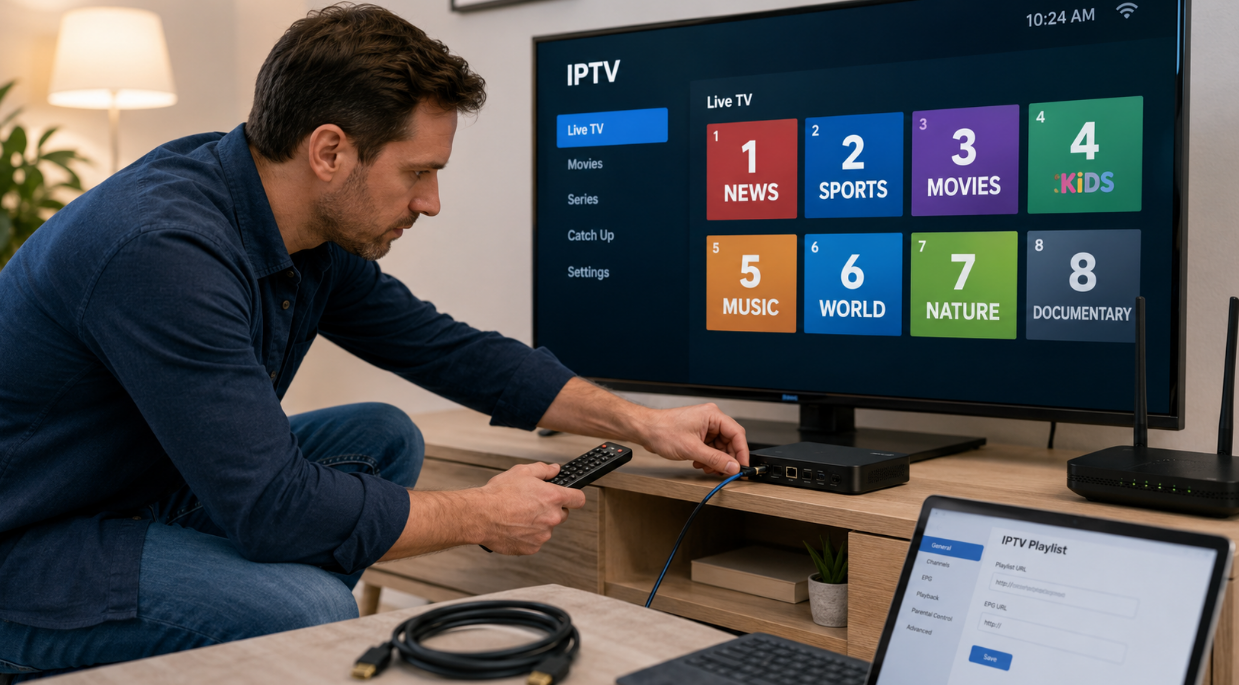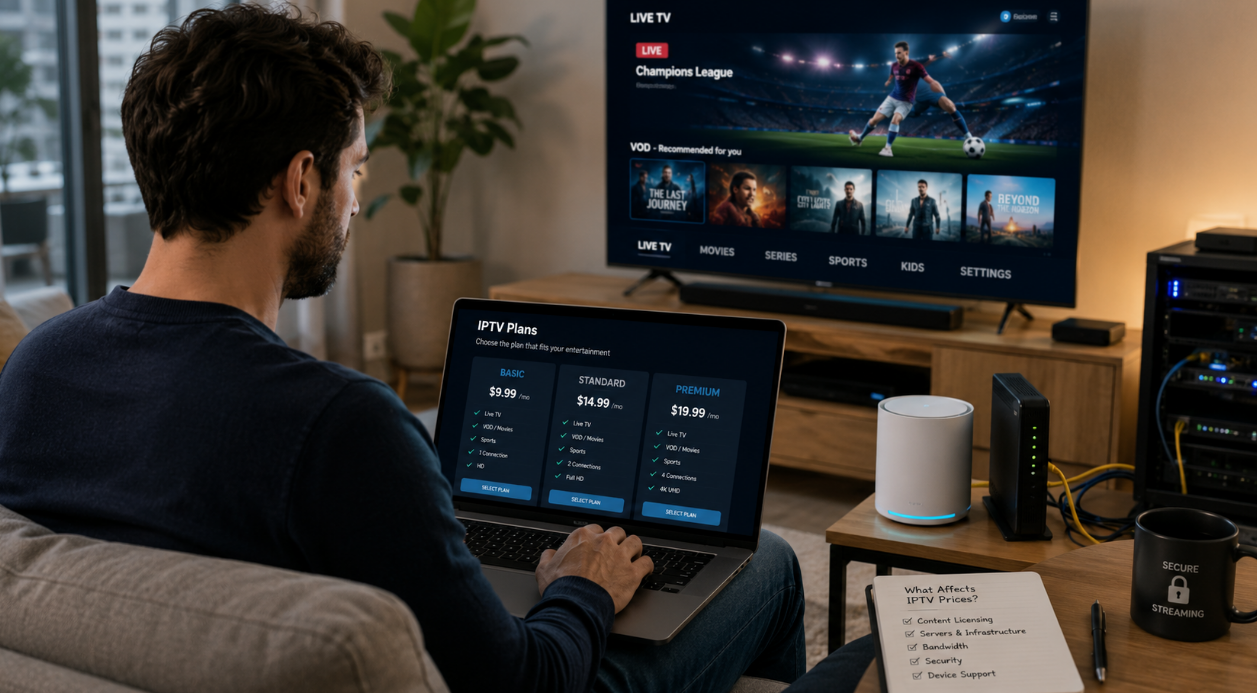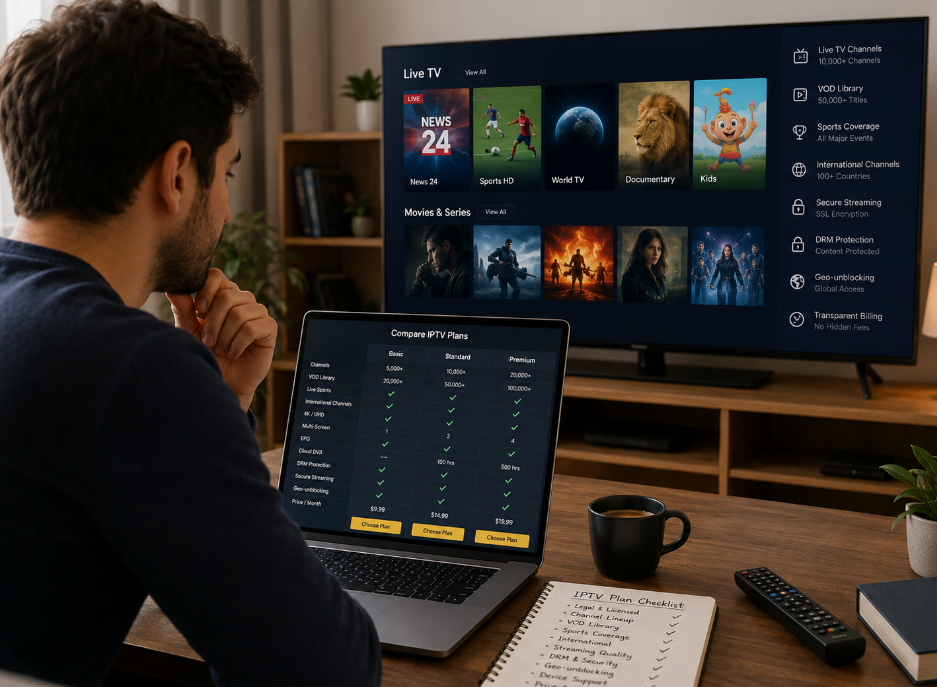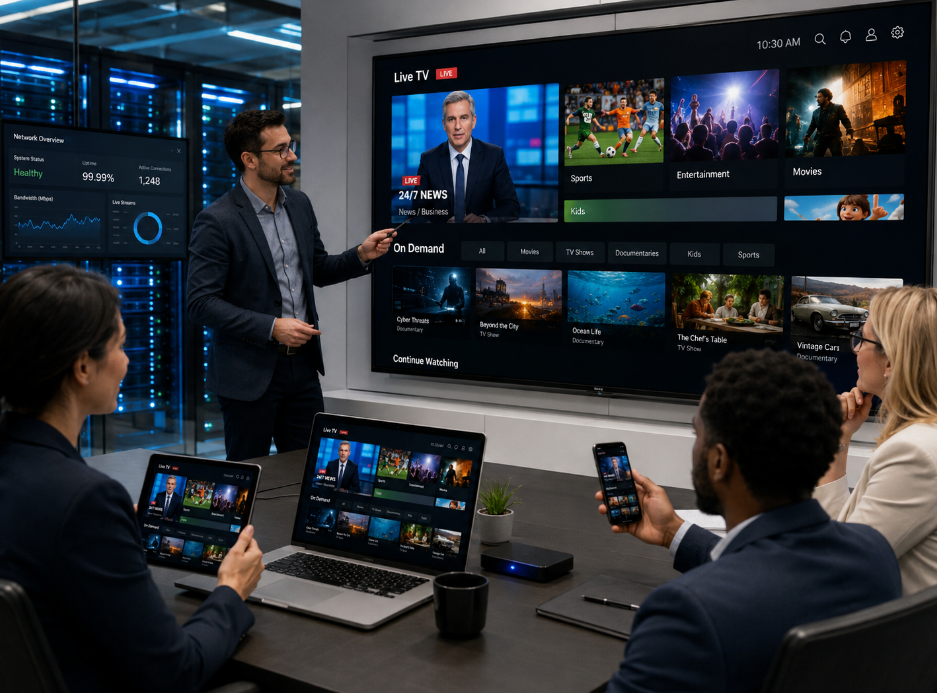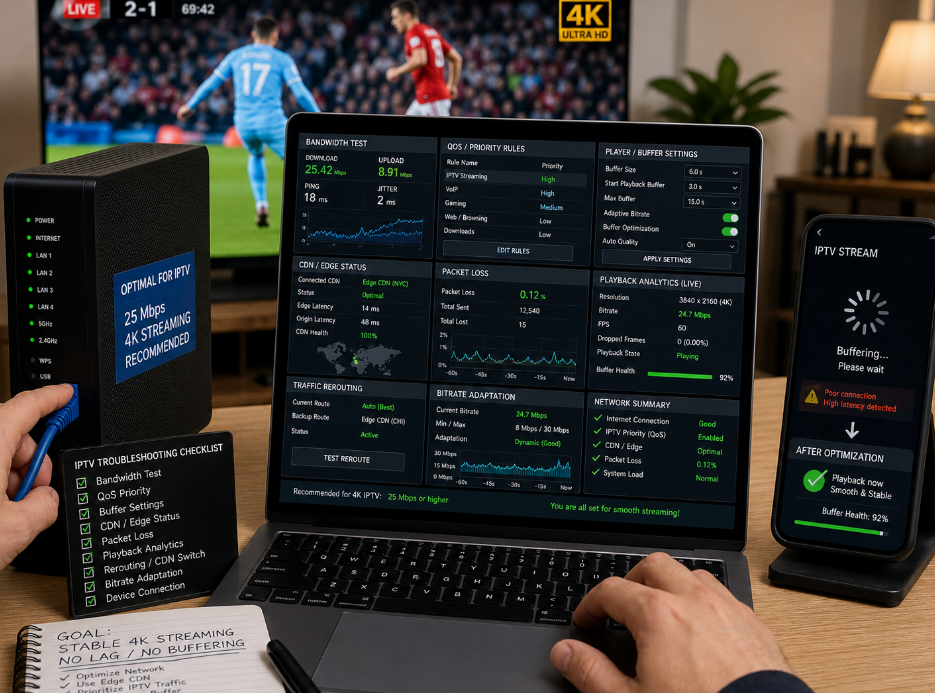
The best ıptv stream player isn’t the flashiest app on the screen—it’s the one that never flakes out when your guests are glued to the game.
Recent reports from Grand View Research highlight sustained enterprise IPTV demand across hospitality and telecom sectors.
Choose wisely, or brace for midnight support calls and refunds and churn.
Reliability First
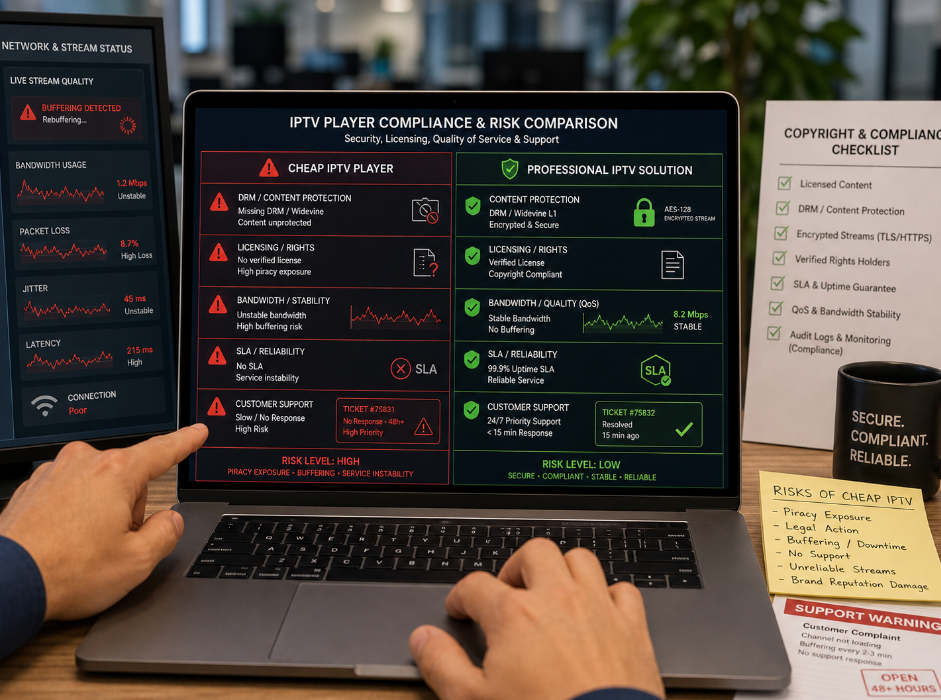
Choose players with robust DRM and SLA-backed bandwidth to avoid buffering and compliance issues.
Decoding Dynamics
Leverage hardware-acceleration or adaptive middleware for stable 4K playback and seamless bitrate switching.
Platform Fit
Match Android or Windows clients to your deployment—mobile flexibility or enterprise integration.
Network Harmony
Optimize last-mile QoS, CDN caching, and analytics monitoring for uninterrupted viewing experiences.
2 Major Pitfalls Of Cheap IPTV Players
Cheap tools can look tempting, especially when an ıptv stream player promises everything for almost nothing. But behind flashy ads, real risks hide in plain sight. Let’s break it down clearly.
Missing DRM Systems and Content Licensing Compliance
An ıptv stream player isn’t just about streaming movies. It must protect content, respect licensing agreements, and follow legal compliance standards. Cheap options often skip that part.
Content Protection Gaps
Higher exposure to stream interception
Increased risk of unauthorized distribution
No encrypted stream handling
Weak or missing content protection layers
Lack of built-in Digital Rights Management
Poor key rotation systems
Licensing Risks
Violations of intellectual property laws
Potential legal penalties for resellers and users
Failure in content audits
Channels pulled without notice
No proof of valid licensing agreements
Exposure to copyright infringement
Regulatory Compliance Issues
Ignoring regional broadcast rules
No structured legal compliance workflow
Weak monitoring of distribution territories
An IPTV player without DRM is basically driving without insurance. It might run fine—until it doesn’t.
According to EUIPO’s online copyright infringement research and ongoing anti-piracy enforcement updates, IPTV piracy and unlicensed streaming continue to create compliance, revenue, and enforcement risks across digital video markets.
That’s why platforms like Startiptv prioritize secure iptv stream architecture and verified content rights. A serious streaming player should protect both viewers and providers, not leave them exposed.

Unreliable Bandwidth Capacity and QoS Guarantees
A smooth ıptv stream player lives or dies by network performance. Cheap providers cut corners here fast.
• Limited CDN reach
• No real Quality of Service enforcement
• Weak redundancy routes
Here’s how the trouble usually unfolds:
Low investment in backbone capacity
Congested peak-hour traffic
Dropping data transfer rates
Noticeable buffering issues
Viewer frustration and churn
You might see:
Random freezes
Audio-video sync errors
High latency problems
Unstable internet connectivity
And the worst part? No enforceable SLA. No uptime guarantee. No compensation.
Multiple short realities hit at once.
Streams stall.
Live sports lag behind real time.
Customer support ghosts you.
Reliable service reliability depends on smart routing, adaptive bitrate control, and serious CDN backing. A modern streaming player should stabilize streaming quality, not gamble with it.
Startiptv builds its iptv stream player environment on scalable bandwidth planning and monitored QoS metrics, keeping playback steady even during traffic spikes. That’s the difference between a bargain app and a dependable IPTV player people can actually trust.
Layered Analysis Of IPTV Video Decoding Methods
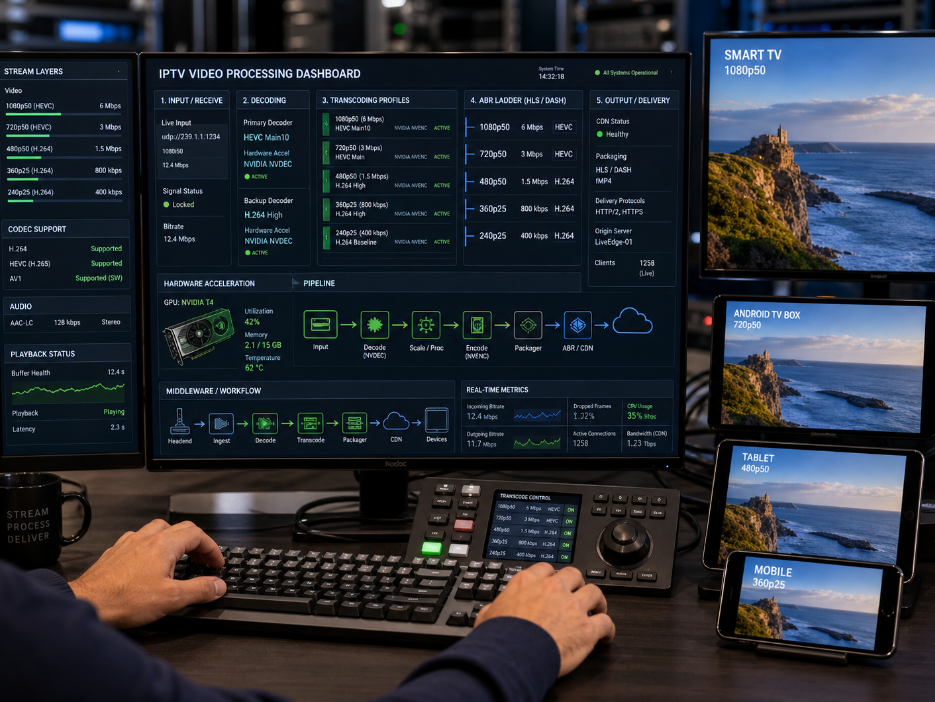
Modern streaming feels instant, yet under the hood it’s a tight dance between chips, code, and network logic. When an ıptv stream player loads a channel, layers of decoding, transcoding, and bitrate control quietly kick in to keep video smooth.
Hardware Accelerated Decoding on Streaming Devices
When an ıptv stream player runs on Smart TVs or Android boxes, hardware decisions shape performance.
Core Processing Layer
Built-in codecs (H.264, HEVC, AV1) reduce CPU strain.
Direct acceleration through GPU pipelines keeps 4K steady.
Chipsets handle dedicated decoding tasks.
Result: smoother video playback across streaming devices.
Device Optimization Layer
Power-efficient hardware acceleration lowers heat and battery drain.
Native firmware aligns decoding paths with panel refresh rates.
Smart TVs
Mobile devices
Player Interaction Layer
The stream player calls system-level APIs.
The ıptv stream player syncs buffer timing with GPU output.
That’s why an IPTV streaming player feels snappy on one box but lags on another. The silicon matters.
Software-Based Transcoding Platforms for Flexibility
Not all streams arrive ready to play. Software engines step in.
• Convert raw feeds into multiple video formats
• Adjust processing loads based on server capacity
• Expand scalability across regions
Ingest live source
Apply transcoding profiles
Distribute optimized streams
A solid ıptv stream player benefits because each platform prepares adaptive versions in advance. If bandwidth dips, the IPTV player switches resolution without drama.
Deloitte’s 2025 Digital Media Trends research describes a video market reshaped by social platforms, creators, user-generated content, and advanced content recommendation systems, reinforcing why scalable software workflows matter for modern streaming.
Flexibility keeps the stream alive on phones, tablets, and smart displays.
Middleware Platforms Handling Adaptive Bitrate Streams
Behind every smooth ıptv stream player session sits middleware logic coordinating adaptive bitrate streaming.
Control Coordination
Signal bitrate ladders to the player.
Package video into segmented files.
Headend Systems
Application Servers
Network Awareness
Monitor network delivery metrics.
Detect congestion in real time.
Playback Response
The player requests a lower bitrate chunk.
The ıptv stream player stabilizes playback without user input.
This layered handshake between platforms, streaming, and network control keeps buffering rare and viewing stress-free.
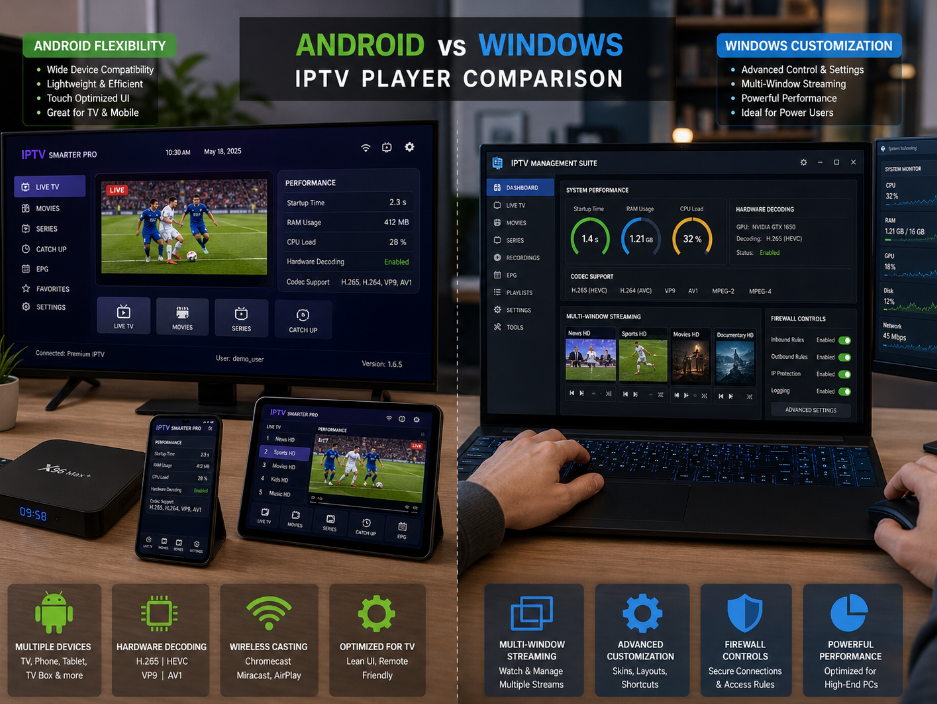
Comparative: Android Vs. Windows IPTV Players
Choosing between Android and Windows for your ıptv stream player setup can feel like picking between a pocket tool and a full workstation. Both handle ıptv stream delivery, smooth stream player controls, and advanced playback tasks. The right iptv player depends on how you stream, where you watch, and how much control you want over performance.
Android IPTV Players
Android devices dominate portable ıptv stream player use. Phones, TV boxes, and Smart TVs all support flexible Streaming and adaptive Playback.
Device Layer
Expandable storage
Custom firmware Features
Remote-friendly layout
Broad Compatibility with IPTV stream apps
Lightweight Interface
Touch-optimized User experience
Mobile
Android TV
TV Boxes
Performance Layer
Adaptive bitrate for fluctuating Wi-Fi
Stable Performance on mid-range chips
Hardware decoding
Network handling
Service Integration
DRM modules
EPG sync
Multi-device login (used by brands like Startiptv)
Typical Android IPTV metrics:
| Device Type | Avg Startup Time (sec) | RAM Usage (MB) | Max Resolution | CPU Load % | App Size (MB) |
|---|---|---|---|---|---|
| Android Phone | 2.1 | 180 | 1080p | 32 | 45 |
| Android TV | 2.8 | 220 | 4K | 40 | 52 |
| TV Box Lite | 3.5 | 250 | 4K | 48 | 60 |
| Premium Box | 1.9 | 300 | 4K HDR | 35 | 75 |
| Tablet | 2.4 | 210 | 1440p | 38 | 50 |
For casual ıptv stream viewing, Android keeps things simple and fast.
Windows IPTV Players
Windows setups feel more technical. An ıptv stream player on desktop supports deeper Features, analytics plug-ins, and advanced Compatibility.
Key strengths:
Broader codec Playback
Multi-window Streaming
Network firewall controls
Typical flow:
Install IPTV stream software.
Configure portal or M3U link.
Adjust buffer and hardware acceleration.
Monitor bandwidth and CPU.
Many IT admins prefer Windows because of stronger Performance tracking and richer Interface customization. Stream player dashboards can integrate monitoring tools, making them fit for offices or control rooms.
For users wanting stability plus brand-backed service, Startiptv runs smoothly on both Android and Windows environments. The best iptv player choice comes down to how hands-on you want your ıptv stream player experience to be.
Pain Point: Laggy Streams? Smooth IPTV Player Tips
Streaming should feel smooth, not like a buffering battle. If your ıptv stream player keeps freezing, the fix usually sits in your network, server path, or player setup. Let’s tighten each layer so your iptv stream player runs clean and steady.
Optimize Network Architecture for Last-Mile Connectivity
A stable network architecture keeps your ıptv stream player from choking at the worst moment. Focus on the last-mile connectivity between your home and provider.
Core infrastructure
Patch security gaps
Improve traffic handling
Central location
Away from metal or thick walls
Router placement
Firmware updates
Bandwidth planning
Check real download speed during peak hours.
Match 4K streaming to at least 25 Mbps per device.
Limit background downloads.
Optimization with QoS
Assign IPTV traffic high priority.
Reduce packet drops during gaming or large uploads.
When your iptv stream player connects through a tuned connectivity path, buffering drops fast. Providers like Startiptv often recommend direct Ethernet for heavy users—it just works better than crowded Wi-Fi.
Leverage CDN Caching and Video Server Distribution
Behind every smooth ıptv stream player sits smart CDN and video server distribution.
Content delivery layers
Load balancing
Traffic rerouting
Shorter routing distance
Lower latency
Edge nodes
Regional clusters
| Metric | Central Server | Edge CDN | Hybrid Distribution |
|---|---|---|---|
| Avg Latency (ms) | 120 | 45 | 60 |
| Packet Loss (%) | 2.8 | 0.9 | 1.2 |
| Peak Load Handling | Medium | High | High |
| Startup Time (sec) | 4.5 | 2.1 | 2.8 |
Ericsson’s Mobility Report data shows that video traffic represents the majority of mobile data traffic, reinforcing why distributed delivery, caching, and network planning matter during peak streaming windows.
That’s why a solid stream player performs better when tied to wide caching and smart edge computing deployment, something Startiptv continues refining across regions.
Tune Player’s Buffer Settings in User Interface Framework
Your player settings matter more than most people think.
In the user interface framework
Increase buffer size slightly for unstable Wi-Fi
Reduce buffer for fast fiber to lower startup latency
Open advanced configuration
Short tweak. Big payoff.
A balanced playback buffer prevents constant reload circles on your ıptv stream player, especially when bandwidth jumps around.
Monitor Performance with Analytics Platforms
Smooth streaming isn’t luck; it’s tracked.
Performance monitoring stack
Daily traffic curves
Device-specific reporting
Bitrate adaptation
Error spikes
Real-time metrics
Historical data dashboards
Track bitrate shifts.
Flag repeated stream failures.
Adjust server routing.
With proper analytics platforms, your iptv stream player stays sharp, your stream player app reacts faster, and your IPTV player experience feels steady night after night.
Scenario-Based: Hotel Lobby IPTV Player Setup
A hotel lobby lives on atmosphere. News, promos, and live events flow through an ıptv stream player, keeping guests engaged while they check in or wait. Smooth streaming matters here.
Deploy Set-Top Boxes with Multi-Screen Support
For a lobby running an ıptv stream player, deployment revolves around tight coordination between hardware and display logic:
Core Hardware Layer
Hidden cabling behind panels
Ventilation clearance to prevent overheating
Commercial-grade processing for stable video output
Multi-port HDMI feeding several display devices
Firmware aligned with the chosen ıptv player environment
Set-top box
Mounting and installation
Control & Interface Layer
Branded welcome screens
Quick-switch channel presets inside the stream player dashboard
Device grouping for synchronized playback
Resolution alignment across multi-screen walls
Centralized configuration
Custom user interface
When a single ıptv stream player pushes identical feeds across screens, timing drift must stay near zero. Proper clock sync inside each set-top box keeps motion graphics and tickers aligned, avoiding that awkward half-second delay guests instantly notice.
Integrate Content Management Systems and Metadata Management
An effective ıptv stream player in hospitality connects deeply with backend systems:
Content management system
Syncs live feeds and scheduled promos
Distributes media assets to lobby endpoints
Integration with headend
Aligns content delivery pipelines
Maps channels into the digital programming guide
Metadata discipline
Accurate metadata tagging
Clean content library indexing for quick retrieval
Inside the ıptv stream player console, staff can swap a morning news feed for an event promo in seconds. A reliable streaming player setup means fewer calls to IT and smoother day-to-day operations.
Ensure Network Security and Service Level Agreements
Security keeps the whole ıptv ecosystem steady:
Network security architecture
VLAN separation
Dedicated firewall rules
Strict access control
Data protection
AES-based data encryption
Credential rotation policies
Operational assurance
Uptime commitments
Escalation timelines
Maintenance windows
Real-time network monitoring
Guaranteed bandwidth
Defined service level agreement
An ıptv stream player tied to a monitored backbone holds stable uptime, even during peak guest traffic. In hospitality, dead screens kill the vibe fast. Secure pipes and clear SLAs keep the content flowing and the lobby energy right where it should be.
References
[IPTV Software Market Size & Share | Industry Report, 2033 - https://www.grandviewresearch.com]
[Encrypted Media Extensions - https://www.w3.org]
[Online Copyright Infringement in the EU Full Report - https://euipo.europa.eu]
[2025 Digital Media Trends - https://www.deloitte.com]
[Netflix-recommended Internet Speeds - https://help.netflix.com]
[Ericsson Mobility Report Data Forecasts - https://www.ericsson.com]
FAQ
What compliance checks matter before investing in an ıptv stream player?
An enterprise rollout can collapse overnight if compliance is ignored. Focus on:
Content licensing & broadcast rights validation
Alignment with copyright laws and local broadcasting rules
Built-in DRM systems tied to approved middleware platforms
Conformity with internal compliance frameworks and data privacy regulations
Miss one element, and live channel feeds or video on demand libraries may be forced offline without warning.
How do bandwidth and network design affect playback stability?
Streaming stability is a chain reaction inside your network architecture:
Adequate bandwidth capacity across the internet backbone
Strong content delivery networks positioned near users
Managed quality of service for IPTV traffic
Protected last-mile connectivity with solid network security
When one link weakens, buffering starts, customer service lines light up, and the network operations center steps in.
Why are DRM and middleware critical in enterprise IPTV systems?
A ıptv stream player is not just a screen—it sits between sensitive assets.
Middleware platforms connect headend systems, transcoding platforms, and video servers.
DRM systems guard premium regional content and subscription tiers.
Content management systems handle metadata management and content aggregation.
Without this structure, storage solutions fill up, rights expire unnoticed, and compliance risks multiply.
Which operational systems keep multi-location IPTV running smoothly?
Short answer: discipline and oversight.
| Operational Element | Purpose | Business Impact |
|---|---|---|
| Network operations center | 24/7 monitoring tools | Faster fault management |
| Service level agreements | Defined uptime targets | Predictable performance |
| Maintenance contracts | Scheduled system checks | Fewer outages |
| Technical support | Rapid escalation paths | Reduced downtime |
Behind every smooth stream is structured service assurance.
How can analytics improve streaming performance and cost control?
An advanced ıptv stream player paired with analytics platforms turns raw data into decisions.
Real-time monitoring of video servers and bandwidth usage
Detection of congestion inside content delivery networks
Forecasting future storage solutions and scaling needs
Insights for billing systems and customer relationship management
Data exposes weak points before viewers notice disruption.
What devices and platforms work best with modern IPTV deployments?
Device compatibility defines user satisfaction.
A strong setup supports:
Smart TVs and certified set-top boxes
Mobile applications and streaming devices
Web browsers with multi-screen support
Android-based players often integrate flexible user interface frameworks and stable transcoding support. When orchestration software coordinates everything behind the scenes, playback feels natural—yet the infrastructure underneath is intense and constantly working.