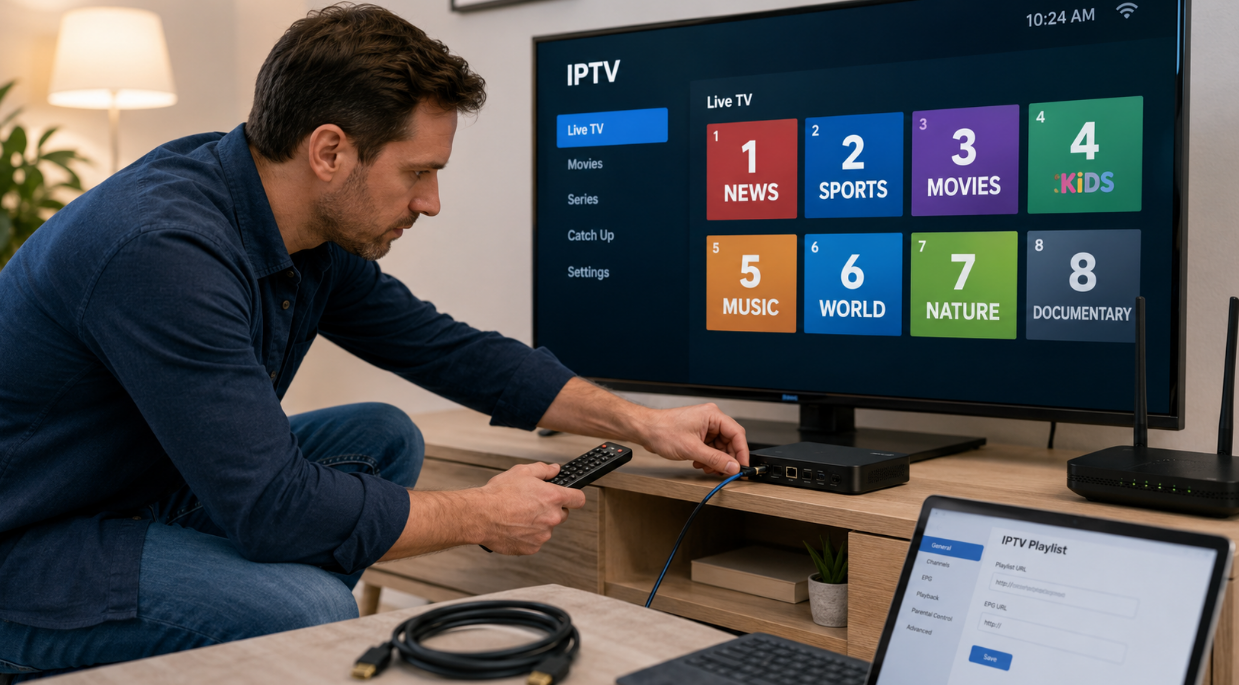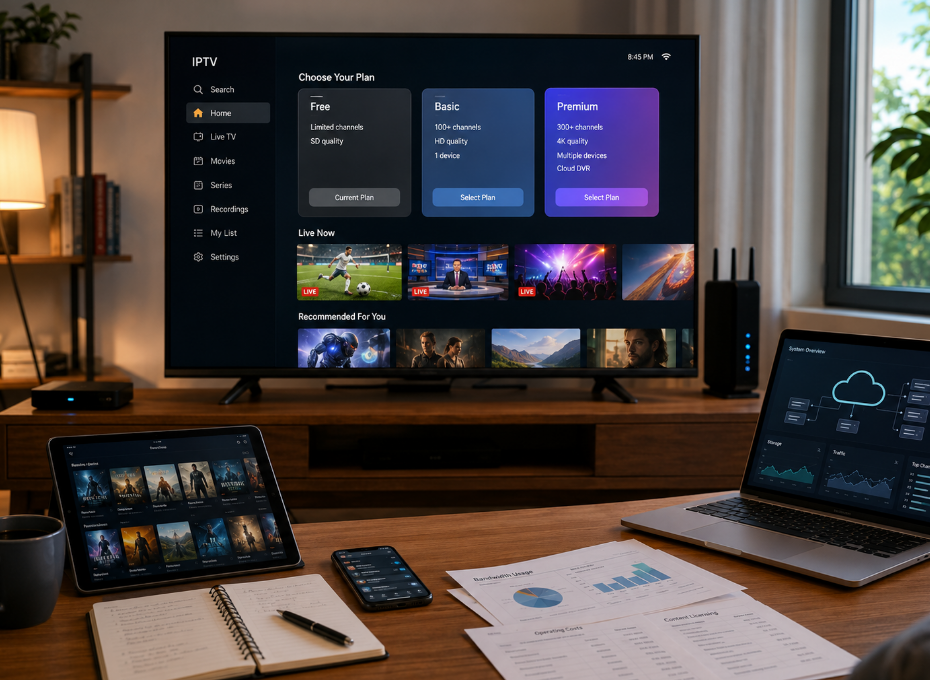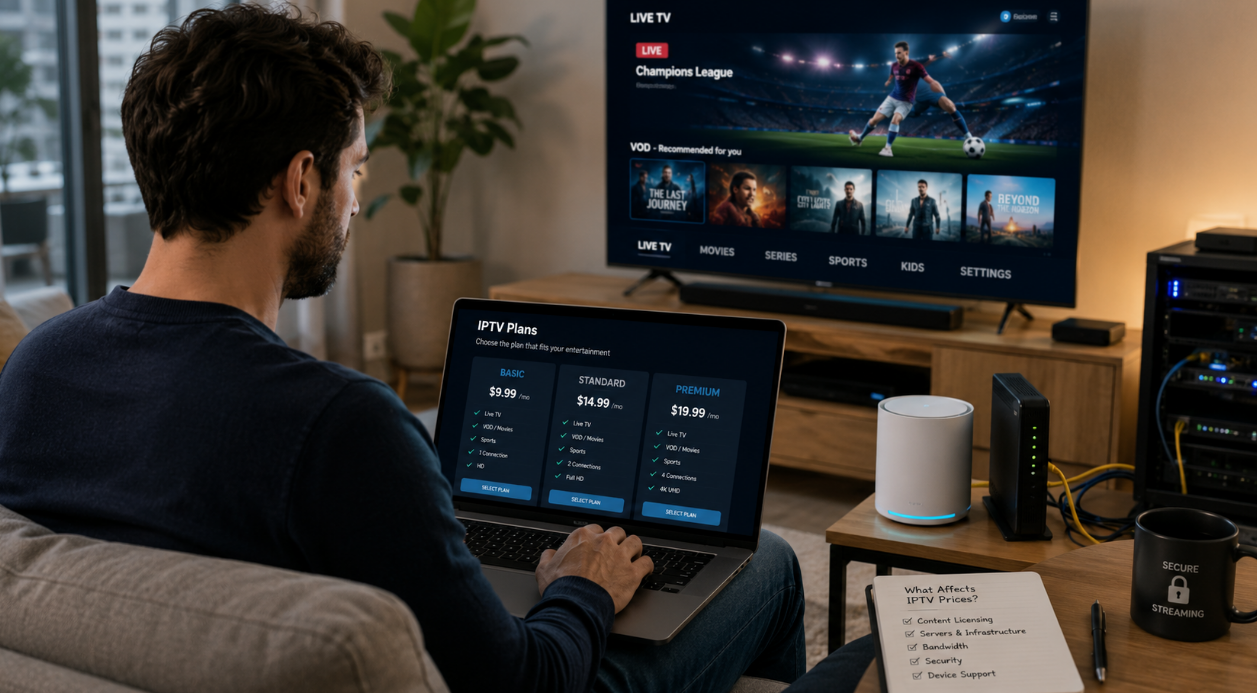
If your iptv platforms can’t scale fast, you’re bleeding opportunity and eyeballs every single day across screens and cities alike right now.
Big buyers want flexibility without tech drama, clear control without babysitting servers, and streaming that just works under heavy demand.
Grand View Research indicates sustained IPTV software market growth through 2033 as operators prioritize scalable infrastructure, on-demand content, broadband penetration, and smart-device adoption.
Scalable Cloud-Native
elastic resource allocation and automated load balancing for seamless growth.
Device Compatibility
universal support across smart TVs, Android/Linux boxes, mobiles, and browsers.
CDN & QoS
global edge caching, adaptive bitrate over fiber, and router-level prioritization for buffer-free streaming.
Security & Monitoring
DRM encryption, access control, real-time dashboards, and log management for compliance and uptime.
Types Of Devices Supporting Sonix IPTV
Streaming today isn’t just about content; it’s about access. Modern iptv platforms run smoothly across TVs, boxes, phones, and computers, letting users switch screens without missing a beat. Here’s how devices handle IPTV systems in real life.
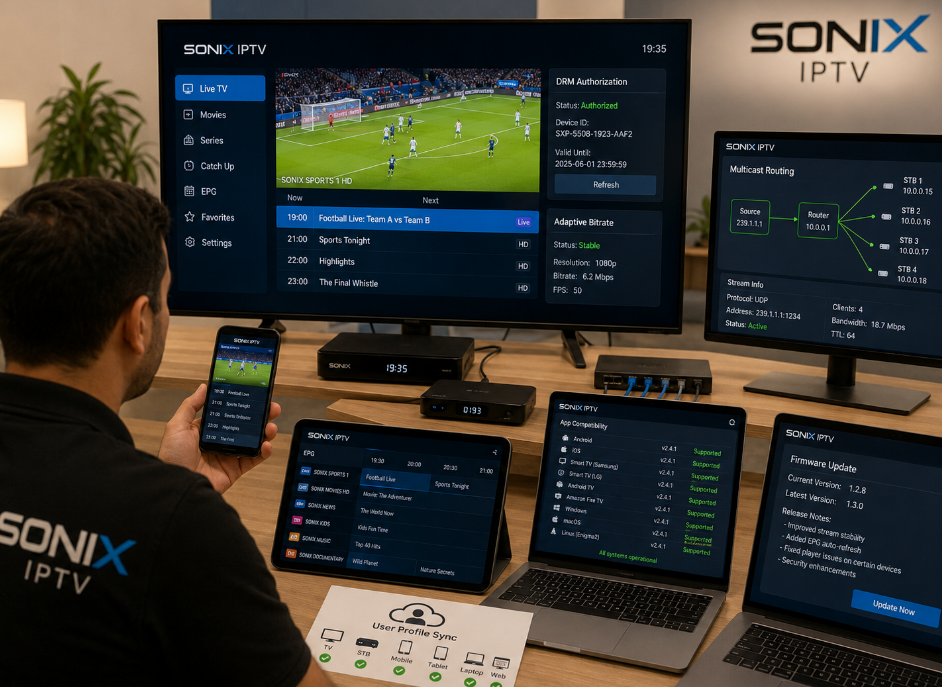
Smart TVs: Built-in Middleware and App Compatibility
Smart TVs have changed the game for iptv platforms by removing the need for extra gear. A modern Television connects straight to IPTV services using built-in features and optimized apps.
Core Device Layer
EPG data processing
DRM handling
Content authorization
Native app stores
Firmware-level video decoding
Built-in features
Middleware
Streaming Functionality
Buffer control
Resolution scaling
IPTV apps supporting adaptive bitrate
Integration with streaming dashboards
App compatibility
Video Optimization
Many IPTV users prefer this setup because it feels plug-and-play. With iptv platforms like IPTV Canada, installation takes minutes, and the streaming flow feels natural on a large screen.
Android & Linux Set-Top Boxes with Headend Integration
For users who want tighter system control, Android and Linux based Set-Top Boxes connect directly to IPTV infrastructure.
Device Foundation
Signal decoding
Multicast handling
Firmware updates
Security patches
Operating system layer
Digital receiver module
Network Interaction
Subscriber authentication
Channel mapping
Stream routing
Headend integration
Performance Control
Transcoding management
Access control modules
This setup gives advanced IPTV platforms more flexibility. According to Ericsson’s Mobility Report, video traffic continues to dominate global mobile networks, reinforcing the demand for scalable IPTV systems.
Ericsson reported that video traffic accounted for 76 percent of all mobile data traffic at the end of 2025.
That’s exactly where best IPTV service Canada fits in, offering stable IPTV platform compatibility across box-based systems.
Mobile Devices: Multi-Screen Support and User Profiles
On Mobile devices, streaming feels personal. A Smartphone or Tablet connects to IPTV platforms through dedicated apps.
Multi-device Access
Watch on phone
Resume on TV
Multi-screen support
Sync playback history
User Layer
Parental control
Personalized watchlists
User profiles
Recommendation logic
Experience Boost
Portability
Personalization
Streaming on the go just works. IPTV platforms adapt bitrate instantly, keeping playback smooth even on mobile data.
PCs & Laptops: Browser-Based Streaming Servers
For desk users, PCs and Laptops rely on Browser-based streaming.
Access Point
Secure login via Web browser
Encrypted playback session
Backend Interaction
Connection to Streaming servers
DRM validation
Session authentication
Device Context
Computer hardware acceleration
Multi-tab viewing on Desktop environments
This approach makes IPTV platforms flexible for office setups or remote work. With IPTV web browser, users simply log in through a browser and stream instantly—no complicated installs, no tech headaches.
Across iptv platforms, device diversity is the real power move. From smart TVs to desktops, IPTV systems keep content flowing wherever people hang out.
What Network Speeds Suit Sonix IPTV Platforms?
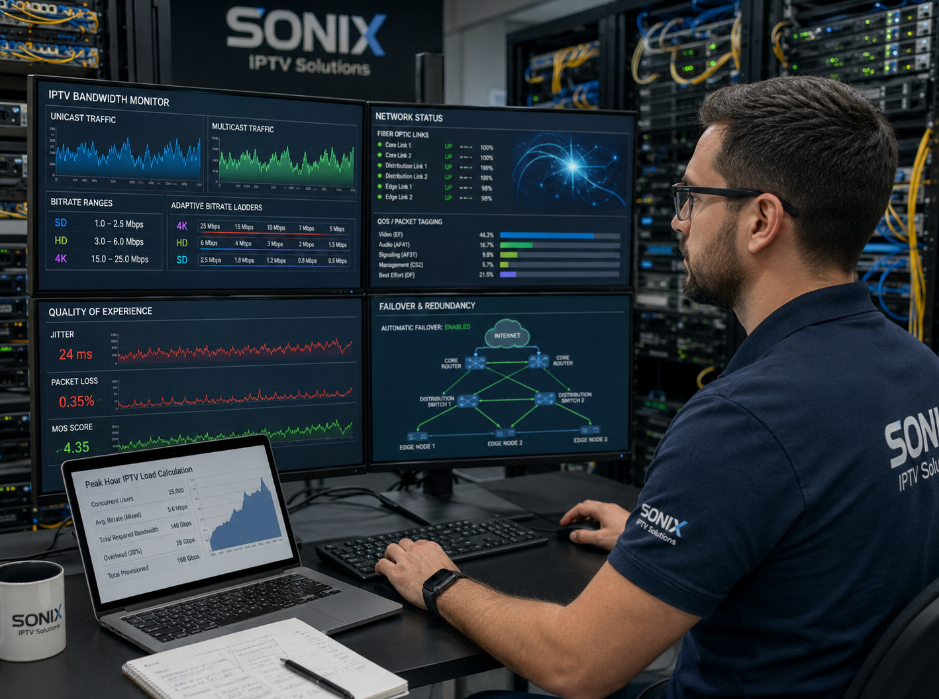
Streaming on modern iptv platforms isn’t rocket science, but your bandwidth and network setup can make or break the vibe. If video buffers, viewers bounce. Let’s break down what keeps IPTV platforms smooth and stress-free.
Minimum Bandwidth Requirements for Unicast and Multicast Streaming
When sizing network capacity for IPTV platforms, it helps to separate unicast from multicast traffic.
Unicast Streaming (one stream per user)
Public internet delivery
Personalized content feeds
Concurrent users multiply total bandwidth demand
Higher compression lowers usage but may affect video quality
SD: 3–5 Mbps
HD: 8–12 Mbps
4K: 20–25 Mbps
Data rate expectations
Impact factors
Best for
Multicast Streaming (one stream, many viewers)
Shared streaming path inside managed networks
Optimized switch fabric reduces duplicated traffic
Ideal for hotels, campuses, and ISP-managed IPTV services
For example, a 50-user HD unicast environment can require 400–600 Mbps sustained throughput. That’s why serious IPTV service providers like IPTV service recommend calculating peak-hour load, not average traffic.
Adaptive Bitrate Delivery Over Fiber Optic Networks
Smooth playback on iptv platforms often depends on adaptive bitrate logic running over stable fiber optics.
Core Components
How It Works
User bandwidth fluctuates
Player requests lower or higher bitrate chunks
Video delivery adjusts without stopping playback
Why Fiber Matters
Low latency across network infrastructure
Symmetrical upload/download speeds
Minimal congestion during peak hours
This combo keeps IPTV systems flexible. On solid fiber, iptv platforms can push crisp HD or 4K without users even noticing bitrate shifts.
Ensuring QoS Mechanisms and Network Redundancy
Stable IPTV platforms depend on tight QoS rules and smart backup planning.
Traffic Prioritization
Tag IPTV packets using network protocols (DSCP/802.1p)
Reduce jitter in busy LAN environments
Limit packet loss under heavy load
Reliability Planning
Dual ISP links for network redundancy
Automatic failover routing
Load-balanced gateways
Performance Monitoring
Track latency in real time
Set alerts for degraded network reliability
Audit router configurations quarterly
If your IPTV service feels rock solid, it’s rarely luck. Providers like IPTV support Canada 24/7 design iptv platforms with layered Quality of Service rules and backup paths so viewers just press play and relax.
4 Factors To Choose Your Sonix IPTV Platform
Choosing among modern iptv platforms can feel like picking a streaming engine for a rocket ship. Speed matters. Stability matters more. And if your IPTV platform can’t scale, users bounce fast. Here’s what truly separates average IPTV services from high-performing streaming systems.

Scalable Cloud-Native Architecture and Load Balancing
When comparing iptv platforms, start with the foundation: scalable, cloud-native, and built for pressure.
Core Architecture
1.1 Cloud-native deployment
1.2 Resource Management
Horizontal elasticity during peak hours
Auto-scaling clusters
Built on microservices
Supports rapid containerization
Traffic Control
2.1 Intelligent load balancing
2.2 Failover routing
| Metric | Small IPTV Platform | Mid IPTV Service | Enterprise IPTV Platforms | Target Benchmark |
|---|---|---|---|---|
| Concurrent Users | 5,000 | 50,000 | 500,000+ | 99.99% uptime |
| Auto-Scaling Time | 5 min | 2 min | <60 sec | <45 sec |
| Downtime/Month | 120 min | 45 min | <5 min | <3 min |
Top IPTV providers like Best IPTV Canada rely on distributed scaling so traffic spikes don’t crash the system.
CDN Integration and Edge Caching Capabilities
Speed sells. Buffering kills retention.
CDN Layer
Global integration
Multi-region distributed network
Delivery Optimization
2.1 Edge caching for hot content
2.2 Smart network optimization
2.3 Real-time latency reduction
Grand View Research reports that the global video streaming market is projected to keep expanding strongly through 2030, which reinforces why distributed streaming infrastructure and regional delivery matter.
Strong IPTV platforms reduce delay by pushing content closer to users. Canada IPTV service integrates multi-node routing to keep streams smooth across devices.
DRM Systems, Content Encryption, and Access Control
Security isn’t optional.
Protection Stack
1.1 DRM systems
1.2 Content encryption
1.3 Token-based authentication
Governance
Granular access control
Multi-layer digital rights enforcement
Continuous content protection
For IPTV platforms handling premium content, missing even one security layer risks shutdown.
Monitoring Dashboards and Fault Detection Tools
Reliable IPTV services run on visibility.
Real-Time Oversight
1.1 Monitoring dashboards tracking performance metrics
1.2 Live system health indicators
Incident Control
Automated alerting
Smart fault detection
Centralized logging
Good IPTV platforms don’t wait for complaints. They catch issues early through real-time analytics. That’s how platforms like iptv testing keep streams stable and subscribers happy.
Smart TV App Vs. Dedicated Box For Sonix IPTV
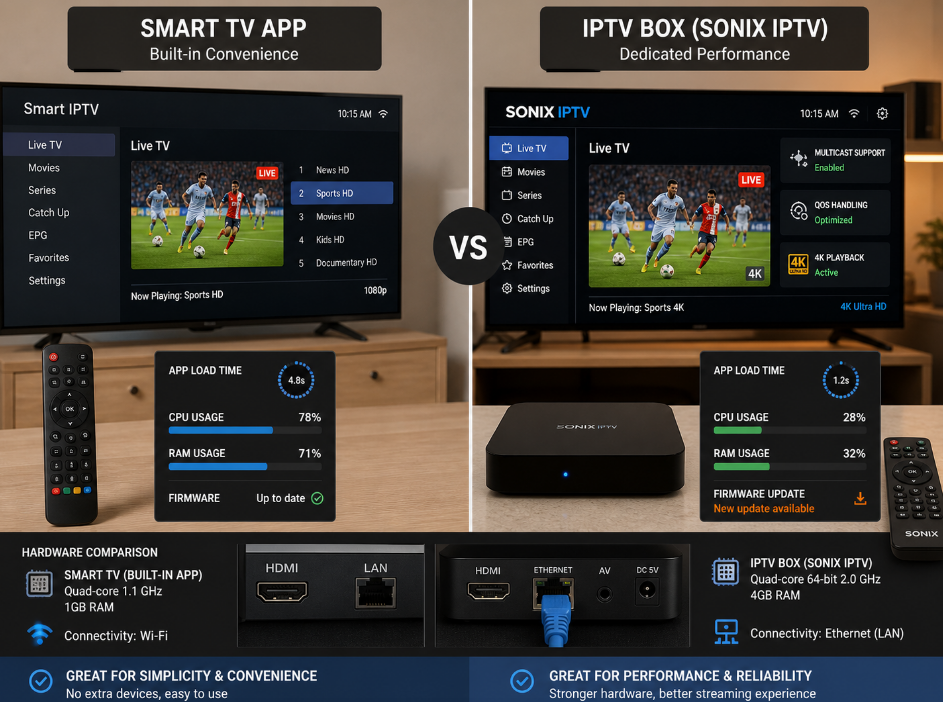
Choosing between Smart TV apps and dedicated boxes for iptv platforms can feel like picking between built-in convenience and raw power. Both power modern IPTV platforms, but the experience depends on hardware, streaming setup, and how serious you are about performance.
Smart TV App
A Smart TV App runs directly through your television’s Application layer and built-in Software, connecting you to iptv platforms without extra Hardware.
Core Environment
Handles Streaming protocols (HLS, MPEG-DASH)
Relies on TV chipset performance
Shares memory with other apps
Integrated with TV menu
Controlled via Remote control
No extra Installation cables
Built-in Interface
Streaming Engine
Performance Factors
Simple navigation
Smooth User experience on newer models
Slower load times on older sets
Updates tied to TV manufacturer
DRM support varies
Firmware dependency
User Interaction
| Feature | Entry TV (2022) | Mid-Range TV (2024) | Premium TV (2025) |
|---|---|---|---|
| CPU Speed (GHz) | 1.2 | 1.8 | 2.4 |
| RAM (GB) | 1.5 | 2 | 3 |
| App Load Time (sec) | 6–8 | 3–5 | 1–2 |
On many iptv platforms, including iptv streaming services like IPTV subscription Canada, app stability depends heavily on your TV specs. IPTV platforms feel smooth on newer panels but can lag on older firmware. For casual IPTV users, this setup keeps things clean and cable-free.
Dedicated Box
A Dedicated Box is an external Device built purely for IPTV platforms. It connects through HDMI Ports, adds stronger Connectivity, and separates streaming from your TV’s internal limits.
Here’s how it stacks up:
Hardware edge
Powerful decoding chip
Expanded memory
Stable Performance under 4K loads
Setup flow
Plug into HDMI Ports
Connect Ethernet or Wi-Fi
Pair Remote
Configure IPTV platforms login
Network stability
Multicast support
Better QoS handling
Reduced buffering during peak hours
Quick comparison snapshot:
Smart TV App → minimal setup, shared resources
Dedicated IPTV box → focused Hardware, optimized streaming
TV app updates → brand-controlled
Box updates → independent firmware cycle
For heavy users of iptv platforms, especially homes running multiple IPTV streams, a box often feels faster and steadier. Services like tv android iptv perform noticeably better when the Device handles transcoding separately from the television.
In short, IPTV platforms on a Smart TV keep things simple. A dedicated IPTV box pushes performance further. Your choice depends on how serious you are about streaming quality—and how much you value clean setup versus raw speed.
Buffering Issues? Optimize Sonix IPTV Settings
Buffering on iptv platforms can feel like hitting traffic during your favorite show. Slowdowns often trace back to misaligned settings, weak bandwidth, or tired servers. This guide breaks down practical tweaks for IPTV platforms, IPTV streaming platforms, and modern IPTV services, with smart adjustments that also fit platforms IPTV users rely on daily, including Startiptv.
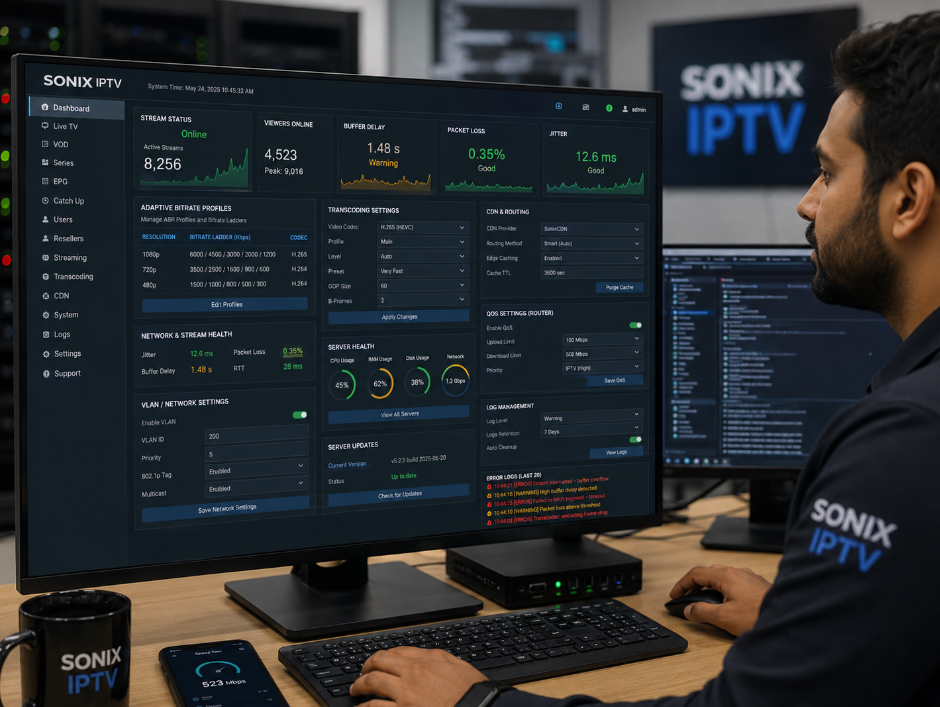
Tweak Adaptive Bitrate and Transcoding Parameters
Smooth playback on iptv platforms starts with tuning adaptive bitrate logic and transcoding parameters.
Adaptive Bitrate Configuration
Packet loss >2% → auto downgrade
Buffer delay >3s → switch profile
1080p – 8 Mbps
720p – 5 Mbps
480p – 2.5 Mbps
Profile Layers
Trigger Rules
Transcoding Optimization
Live sports: prioritize video quality
News streams: prioritize stream optimization
H.264 for broad IPTV streaming platforms compatibility
H.265 for reduced bandwidth consumption
Codec Settings
Bitrate Caps
| Profile | Resolution | Bitrate (Mbps) | Avg Buffer Time (ms) |
|---|---|---|---|
| High | 1080p | 8.0 | 900 |
| Medium | 720p | 5.0 | 650 |
| Low | 480p | 2.5 | 400 |
Fine-tuned settings like these help IPTV platforms react fast when networks wobble. best IPTV devices Canada applies similar dynamic bitrate scaling to keep streams steady across different IPTV services.
Leverage CDN Integration and Edge Caching
If iptv platforms rely on a single origin server, buffering creeps in fast. Smart CDN deployment spreads content delivery across regional nodes.
Reduce latency reduction gaps by placing content closer to viewers.
Use edge caching for high-demand channels.
Balance data distribution during peak hours.
A quick rollout often looks like this:
Connect origin server to CDN provider.
Enable regional server proximity routing.
Cache top 20% most-watched streams.
Short bursts of traffic won’t crush your network performance anymore. On platforms IPTV users stream daily, this setup keeps sports finals from freezing mid-goal. IPTV sports channels Canada integrates CDN routing to stabilize IPTV platforms during heavy load without overloading storage nodes.
Configure Router Settings for Improved QoS
On local networks, poor router settings quietly sabotage IPTV platforms.
Core Network Configuration
Enable VLAN tagging for IPTV traffic.
Assign static IP to middleware server.
QoS Policies
Reserve 40% for IPTV streaming platforms.
High: IPTV multicast/unicast
Medium: Web browsing
Low: Downloads
Traffic Classes
Bandwidth Prioritization
Traffic Control
Activate smart queue management.
Monitor internet connection jitter (<30 ms ideal).
Track traffic management logs weekly.
Clean prioritization boosts network performance across IPTV platforms and other connected IPTV services at home or in commercial setups.
Keep Streaming Servers Updated and Log Management Active
Steady IPTV platforms need disciplined upkeep.
Schedule monthly server updates for OS and middleware.
Patch encoder firmware quarterly.
Enable automated log management with 30-day retention.
Review performance monitoring dashboards weekly.
Audit error logging alerts for packet drops or CPU spikes.
Run quarterly system maintenance checks on storage arrays.
Track server health metrics: CPU (<70%), RAM (<75%), disk I/O latency (<10 ms).
Consistent upkeep prevents random crashes that frustrate users on IPTV streaming platforms. IPTV support Canada 24/7 maintains rolling updates and active diagnostics so IPTV platforms stay responsive even during peak streaming hours.
Office Setup: Sonix IPTV Platforms For Teams
Modern offices expect iptv platforms to run as smoothly as email or chat. From meeting rooms to shared lounges, strong IPTV and smart platforms keep teams in sync. The right IPTV platform setup blends access, control, and speed without turning IT into a headache.
Multi-Screen Support with Shared EPG and Profiles
Strong iptv platforms in office setups rely on layered coordination:
Device Layer
1.1 Multi-device compatibility across smart TVs, tablets, and desktops
1.2 Stable device compatibility for mixed operating systems
1.3 Support for simultaneous viewing during town halls
Access & Interface Layer
2.1 Unified EPG with shared scheduling across rooms
2.2 Centralized user profiles for HR, sales, and leadership
2.3 Secure personalization rules tied to login credentials
Content Layer
3.1 Real-time content sharing between conference rooms
3.2 Synchronized VOD libraries on all IPTV platforms
3.3 Managed IPTV systems that prevent duplicate streams
With Canadian IPTV provider, teams get IPTV platforms that sync profiles instantly, so a user walking from Room A to Room B keeps preferences intact. That’s how modern IPTV platforms should feel—quick, clean, no drama.
API, SSO Protocols, and CRM Integration
Corporate iptv platforms depend on structured connectivity:
Integration Framework
1.1 Open API endpoints for billing and analytics
1.2 Secure integration pipelines with ERP tools
1.3 Controlled data synchronization across apps
Identity & Access
2.1 Enterprise-grade SSO login systems
2.2 Standardized protocols for encrypted exchange
2.3 Central authentication server validation
Business Systems
3.1 Direct CRM linkage for customer-facing dashboards
3.2 Clean system interoperability between IPTV services and HR portals
3.3 Usage analytics fed into reporting tools
Gartner defines integration platform as a service as a vendor-managed cloud service that enables integrations between applications, services, and data sources, which supports the article’s API-centered interoperability logic.
That’s the logic behind Canada IPTV service—its IPTV platform design plugs into existing corporate IPTV ecosystems without forcing a rebuild.

Broadband Connectivity, Switch Fabric, and Load Balancing
Even the best iptv platforms fall apart without strong pipes behind them:
Core Network Foundation
1.1 High-capacity broadband contracts
1.2 Stable connectivity across VLAN segments
1.3 Structured network infrastructure planning
Internal Distribution
2.1 Redundant switch fabric layouts
2.2 Controlled data traffic routing rules
2.3 Segmented IPTV systems for priority rooms
Performance Control
3.1 Smart load balancing during peak events
3.2 Dynamic bandwidth allocation
3.3 Continuous network optimization monitoring
Reliable IPTV platforms don’t guess; they measure. When bandwidth spikes during live CEO streams, the IPTV platform redistributes load in seconds. IPTV service for Canada sports aligns IPTV services with corporate-grade network standards, keeping office IPTV platforms steady, even on busy days.
References
[Grand View Research IPTV Software Market Report - https://www.grandviewresearch.com/industry-analysis/iptv-software-market-report]
[Grand View Research Video Streaming Market Report - https://www.grandviewresearch.com/industry-analysis/video-streaming-market]
[Ericsson Mobility Report Mobile Traffic Update - https://www.ericsson.com/en/reports-and-papers/mobility-report/dataforecasts/mobile-traffic-update]
[Apple HTTP Live Streaming Developer Documentation - https://developer.apple.com/streaming/]
[DASH Industry Forum MPEG-DASH Overview - https://dashif.org/about/]
[Cisco Nexus 9000 QoS Marking Documentation - https://www.cisco.com/]
[Gartner Integration Platform as a Service Reviews - https://www.gartner.com/]
FAQ
What devices work best with IPTV platforms in enterprise environments?
IPTV platforms adapt to different corporate setups through layered architecture:
Smart TVs – built-in middleware, DRM systems, direct app access
Android/Linux set-top boxes – connected to the headend with multicast streaming support
PCs & laptops – browser access via streaming servers and database management
Mobile devices – multi-screen support, user profiles, adaptive bitrate over broadband connectivity
For controlled office networks, dedicated boxes often deliver higher stability through better QoS mechanisms and router configuration control.
How much bandwidth is required for stable IPTV platforms?
Performance depends on delivery method and network design.
Unicast streaming: 8–25 Mbps per HD channel
Multicast streaming: Optimized for switch fabric environments, reducing internal traffic
Fiber optic networks: Improve latency and adaptive bitrate consistency
QoS mechanisms + IP addressing planning: Prevent congestion during peak usage
Add network redundancy and edge caching to maintain steady playback during high-demand sessions.
How do IPTV platforms scale using cloud-native architecture?
Modern IPTV platforms grow through flexible backend design:
Cloud-native deployment with automated load balancing
Container-based middleware and transcoding services
Dynamic resource allocation during traffic spikes
Integrated monitoring dashboards with system alerts and performance metrics
This structure keeps streaming servers responsive while simplifying software updates and fault detection across regions.
How do IPTV platforms ensure security and business integration?
Security and integration operate side by side inside enterprise ecosystems.
Security Layer Includes:
DRM systems & content encryption
Subscriber authentication & access control
Watermarking & regulatory compliance policies
Data privacy safeguards
Integration Capabilities:
| Function | Business Impact |
|---|---|
| CRM integration | Subscriber lifecycle tracking |
| Billing system integration | Automated invoicing |
| SSO protocols | Simplified employee access |
| API documentation | Third-party applications |
| Analytics platforms | Usage insights & content optimization |
Together, these elements protect content while supporting EPG services, VOD library access, timeshift TV, and nPVR experiences across the organization.